Thursday, February 13, 2014

Revised Social Studies Framework

The new National Council for the Social Studies (Common Core) Standards have been released with their recommendations to States.

The full title:  The College, Career and Civic Life (c3) for Social Studies State Standards: Guidance for Enhancing the Rigor of K-12 Civics, Economics, Geography, and History

The recommendations are broken down by "Dimensions."

Dimension 1 stresses the importance of anchoring these standards with the current Common Core ELA Standards.  The new Social Studies Standards require that students learn how to ask compelling questions, determine what are "reliable" sources, and cite textual evidence.

Dimension 2 is broken down into four categories.  Civics, Economics, Geography, and History.

Some Standards include:

Civics:

Kindergarten - 2nd Grade
D2.Civ.1.K-2. Describe roles and responsibilities of people in authority.
D2.Civ.3.K-2. Explain the need for and purposes of rules in various settings inside and outside of school  (never question authority, those in power know what is best for you)
D2.Civ.8.K-2. Describe democratic principles such as equality, fairness, and respect for legitimate authority and rules.
D2.Civ.9. K-2  Follow agreed-upon rules for discussions while responding attentively to others when addressing ideas and making decisions as a group (instilling the idea of collectivism and that we are a democracy)

Grade 9-12

D2.Civ.1.9-12  Distinguish the powers and responsibilities of local, state, tribal, national, and international civic and political institutions.
D2.Civ.3.9-12  Analyze the impact of constitutions, laws, treaties, and international agreements on the maintenance of national and international order.
D2.Civ.7.9-12. Apply civic virtues and democratic principles when working with others.
(more indoctrination that we are a democracy)

Economics: 

Kindergarten- 2nd Grade
D2.Eco.1.K-2. Explain how scarcity necessitates decision making. 
D2.Eco.2.K-2. Identify the benefits and costs of making various personal decisions.

5th Grade

D2.Eco.3.3-5. Identify examples of the variety of resources (human capital, physical capital, and natural resources) that are used to produce goods and services.
D2.Eco.6.3-5. Explain the relationship between investment in human capital, productivity, and future incomes.
D2.Eco.12 3-5. Explain the ways in which the government pays for the goods and services it provides.
D2.Eco.13. 3-5.  Describe ways people can increase productivity by using improved capital goods and improving their human capital.

8th Grade
D2.Eco.1.6-8. Explain how economic decisions affect the well-being of individuals, businesses, and society.
D2.Eco.9.6-8. Describe the roles of institutions such as corporations, non-profits, and labor unions in a market economy

12th Grade

D2.Eco.1.9-12. Analyze how incentives influence choices that may result in policies with a range of costs and benefits for different groups.
D2.Eco.5.9-12. Describe the consequences of competition in specific markets.
D2.Eco.6.9-12. Generate possible explanations for a government role in markets when market inefficiencies exist.
D2.Eco.15.9-12. Explain how current globalization trends and policies affect economic growth, labor markets, rights of citizens, the environment, and resource and income distribution in different nations.

GEOGRAPHY:

Kindergarten- 2nd Grade
D2.Geo.5.K-2. Describe how human activities affect the cultural and environmental characteristics of places or regions.

12th Grade
D2.Geo.6.9-12.  Evaluate the impact of human settlement activities on the environmental and cultural characteristics of specific places and regions.
D2.Geo.12.9-12. Evaluate the consequences of human-made and natural catastrophes on global trade, politics, and human migration.

HISTORY:  (less emphasis on the actual historical events and people and more emphasis on what the collective THINKS happened)

Kindergarten - 2nd Grade
D2.His.6.K-2. Compare different accounts of the same historical event.
D2.His.12.K-2  Generate questions about a particular historical source as it relates to a particular historical event or development.
D2.His16.K-2  Select which reasons might be more likely than others to explain a historical event or development.


12th Grade

D2.His.8.9-12.  Analyze how current interpretations of the past are limited by the extent to which available historical sources represent perspectives of people at the time.
D2.His.13.9-12  Critique the appropriateness of the historical sources used in a secondary interpretation.
D2.His.17.9-12  Critique the central arguments in secondary works of history on related topics in multiple media in terms of their historical accuracy.


Dimension 3:  Evaluation Sources and Using Evidence

This dimension emphasizes using sources to analyze information and come to a conclusion to a claim.

Now, imagine schools have iPads or laptops for each student to use in order to research and analyze information.  Imagine that these devices come pre-loaded with search engines.  Then, imagine that there was something called the Learning Resource Metadata Initiative.  We warned about this initiative before that involved the Department of Education and George Soros.  With search engines that only direct students to certain articles and omit opposing viewpoints or information (think China), it might make it really hard for a student to write a paper on an opposing view because they would not be able to find sources to support their argument.

Dimension 4:  Communicating Conclusions and Taking Informed Action

This Dimension is the most disturbing.  It is all about training children to become activists.


It states, "...state social studies standards should consider including expectations for students to collaborate with others as they communicate and critique their conclusions in public venues.  These venues may range from the school classroom to the larger public community.  Collaborative efforts may range from teaming up to work on a group presentation with classmates to actual work on a local issue that could involve addressing real-world problems."

Students are encouraged to critique the work of others and determine the credibility of the sources used.

Kindergarten - 2nd Grade
D4.6.K-2. Identify and explain a range of local, regional, and global problems and some ways in which people are trying to address these problems.
D4.7.K-2. Identify ways to take action to help address local, regional, and global problems.
D4.8.K-2.  Use listening, consensus-building, and voting procedures to decide on and take action in their classrooms.

12th Grade

D4.7.6-8.  Assess their individual and collective capacities to take action to address local, regional, and global problems, taking into account a range of possible levers of power, strategies, and potential outcomes.
D4.8.6-8. Apply a range of deliberative and democratic procedures to make decisions and take action in their classrooms and schools and in out-of-school civic context.


Any reference to specific historical events or figures or reference to our Declaration of Independence, Constitution, Bill of Rights or any amendments have been completely omitted from the Social Studies Standards.

Next, we'll show you how states have taken these new standards and adapted them into their own State Standards.


Tuesday, February 11, 2014

President's Day. Less About Washington. More About Obama.

Washington was born on February 11, 1731.  Americans celebrated Washington's Birthday long before congress declared it a federal holiday.


According to the National Archives, "The centennial of his birth prompted festivities nationally and Congress established a Joint Committee to arrange for the occasion.  At the recommendation of the committee, chaired by Henry Clay of the Senate and Philemon Thomas of the House, Congress adjourned on February 22, 1832 out of respect for Washington's memory and in commemoration of his birth.

Prompted by a memorial from the mayor and other citizens of Philadelphia, the House and Senate commemorated the 130th Anniversary of Washington's birth by reading aloud his Farewell Address.  In a special joint session held in the House Chamber, the House and Senate, along with several cabinet officials, Justices of the Supreme Court and high-ranking officers of the Army and Navy, gathered to listen to the Secretary of State read the address aloud.  Eventually, the reading of George Washington's Farewell Address became an annual event for the Senate, a tradition that is still observed to this day.

Contrary to popular belief, neither Congress nor the President has ever stipulated that the name of the holiday observed as Washington's Birthday be changed to 'President's Day.'  "


We would like to show you samples of material that schools use as Common Core aligned "informational text" by ReadWorks to celebrate President's Day:  


(suggested answer:  Barack Obama was the first African American to be elected president.)

Another Common Core aligned kindergarten lesson plan celebrating President's Day inserts information about President Obama between George Washington and Abraham Lincoln.  The lesson goes a step further to teach that our country is a "democracy" rather than a representative "republic."


Of course, Obama has been inserted into the holiday since his first President's Day in office.  From February 2009:

"President Barack Obama's picture was removed this week from a Presidents Day sign at the Peterson Air Force Base commissary after customers complained that the image did not fit the holiday commemorating the birthdays of past presidents George Washington and Abraham Lincoln.

They said four customers had complained that Presidents Day is to honor Washington and Lincoln, not Obama, causing the agency to remove the Obama image.


'The customers stated it is inaccurate to associate other presidents with this holiday and asked that we remove President Obama’s photo from the flier,' the agency said in a statement."


Just wait until we publish our findings of the newly revised Social Studies Framework....

Monday, November 25, 2013

Sunlight Is The Best Disinfectant

Just let the leftist elite keep talking.  Sooner or later, they will say what they REALLY mean.

Sunlight is the best disinfectant. 

Take Obama's Secretary of Education, Arne Duncan, for example who recently let it slip in front of State Superintendents at a meeting with the Council of Chief State School Officers that "some of the opposition to the Common Core State Standards has come from 'white suburban moms who-all of a sudden- their child isn't as brilliant as they thought they were, and their school isn't quite as good as they thought they were.' "


The words bigot, sexist, bully, arrogant, and intolerant come to mind.

Also, when these kinds of things accidentally "slip" in public, it makes one wonder what is said behind closed doors.

Arne Duncan also let it slip in 2009 what the real goal of data collection will be to the federal government.

"We should be able to look every second grader in the eye and say, 'You're on track, you're going to be able to go to a good college, or you're not.' "


Think this is a little far-fetched?

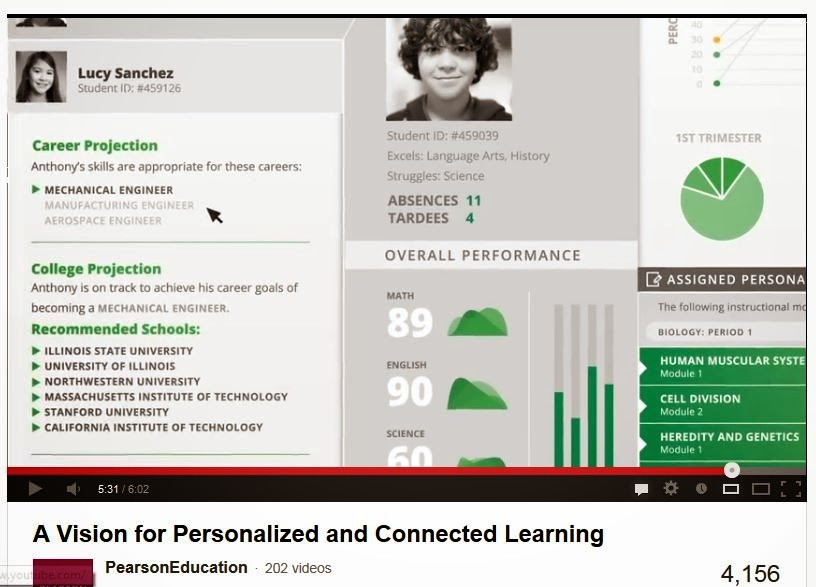
Just look at what Pearson's data track will be able to do for a student like "Anthony."  It's just a shame that Anthony is projected to be a mechanical or aerospace engineer with a 60% average in science.  

Or, maybe not?


Thursday, November 21, 2013

What Do The Race To The Top - District Competition And Arizona Senator Steve Gallardo Have In Common?

In September we brought to your attention a new federal grant called the "Race to the Top District" competition.  This is an expansion of the 2010 State Race to the Top grant.  Grant awards range between $4M and $30M per district or consortia.

The school district who applies for this grant must meet some of the following requirements:

- Have at least 40% of participating students be from low-income families, based on eligibility for free or reduced-price lunch subsidies.

-  Include a "Competitive Preference Priority" and propose to extend reforms beyond the classroom and partner with public or private entities in order to address the social, emotional, and behavioral needs of students.

-  At a minimum, design and commit to implement no later than the 2014-15 school year a

1.  Teacher evaluation system
2.  Principal evaluation system
3.  Superintendent evaluation system

Additional requirements include:


"The LEA or consortium will submit a report to the Secretary?"

That sounds an awful lot like the federal government is directing the education of a local school district.  We didn't think that was legal even on a State level, let alone, a district level.


Finalists for the grant competition were recently announced.  On the list was the Arizona Cartwright School District.    The Cartwright District is eligible to win up to $25M.  To put this number in perspective, the 2014 budget submitted by the district was $95M. 


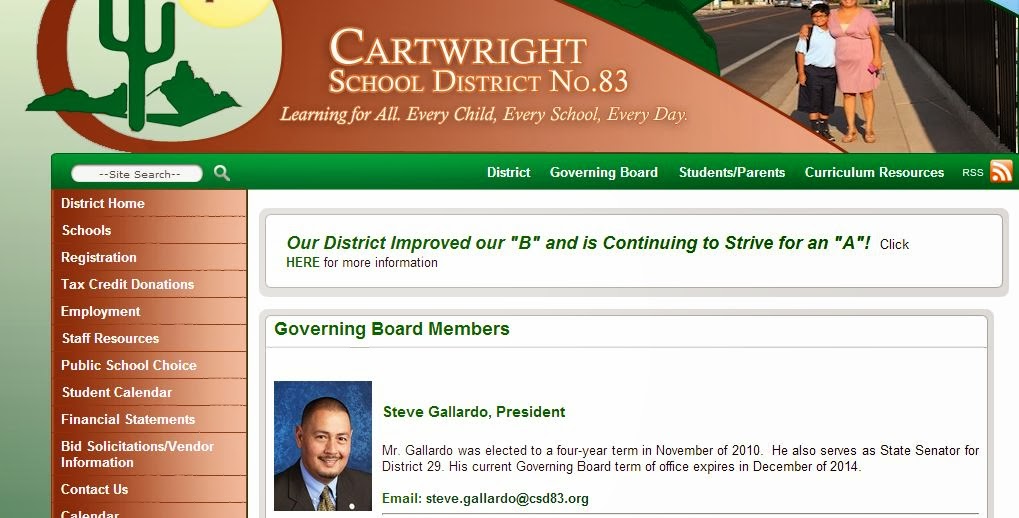
And who is the district's Governing School Board President?


And fellow board member is Arizona Representative, Lydia Hernandez.

From their district website homepage:


Awards will be announced in December 2013.

Let us be the first to be on record to say that if the Cartwright School District "wins" their $30M taxpayer funded grant, Senator Gallardo and Representative Hernandez will still whine and complain about any State education budget cuts in the spring.


Tuesday, November 12, 2013

Get Covered America Pushes "Faith Based" Enrollment Among Latinos


We wonder how many Mormon Bishops or trusted local church leaders will allow members of their congregation to be enrolled in Obamacare using this method?  After all, Get Covered America employees, as well as church leaders, shy away from asking about a person's legal status.


Get Covered America might want to update their contact information as Gordon B. Hinckley passed away the same week as Obama's inauguration in 2008.


Thursday, November 7, 2013

How The Federal Government Cleverly Played A Role In Drafting The Common Core Standards

Oh, the federal government claims they had nothing to do with writing the Standards.  They just paid for them.

But what if one of the lead writers for, say, the ELA Standards also sat on the NAEP (National Assessment of Educational Progress) Governing Board whose members are appointed by the Secretary of Education?

And what if the Governing Board members were deemed to be "federal employees?"


We have discussed Susan Pimentel before.  She was one of the lead ELA Standards writers and a member of the Standards "Work Group."  She was also re-appointed to the NAEP governing board by Arne Duncan in September 2011.

We stated in a previous entry that Susan Pimentel was the Director or Standards Works and Achieve, Inc.


In 1999 she authored the book, "Raising the Standard:  A Eight-Step Guide For Schools And Communities."  In the book she writes about laying the groundwork for lasting school reform because genuine, long-lasting reform grows from the grass-roots.  She lists organizations that can help "guide" the standards such as Achieve and the American Federation of Teachers (AFL-CIO).  
She said, "Ours is a society that thrives on change...Reform is hard work."

Pimentel donated over $22,000 to Democrats in 2012 (mostly to Obama's campaign).  Significantly more than the $4000 donations she made in 2008.


Sneaky.

Monday, November 4, 2013

New York School Principal Promotes Test Prep Company

The Center Moriches High School Principal and President of the Suffolk County Principal Association, Edward Casswell, has been caught promoting a testing company, Method Test Prep, using a school computer in his PUBLIC high school office.


One might wonder what kind of incentive Mr. Casswell or the school received for his glowing, "scripted" endorsement.

The President of Method Test Prep, Tom Ehlers, claims that the school is paid for each student who takes the course.

For the children.....